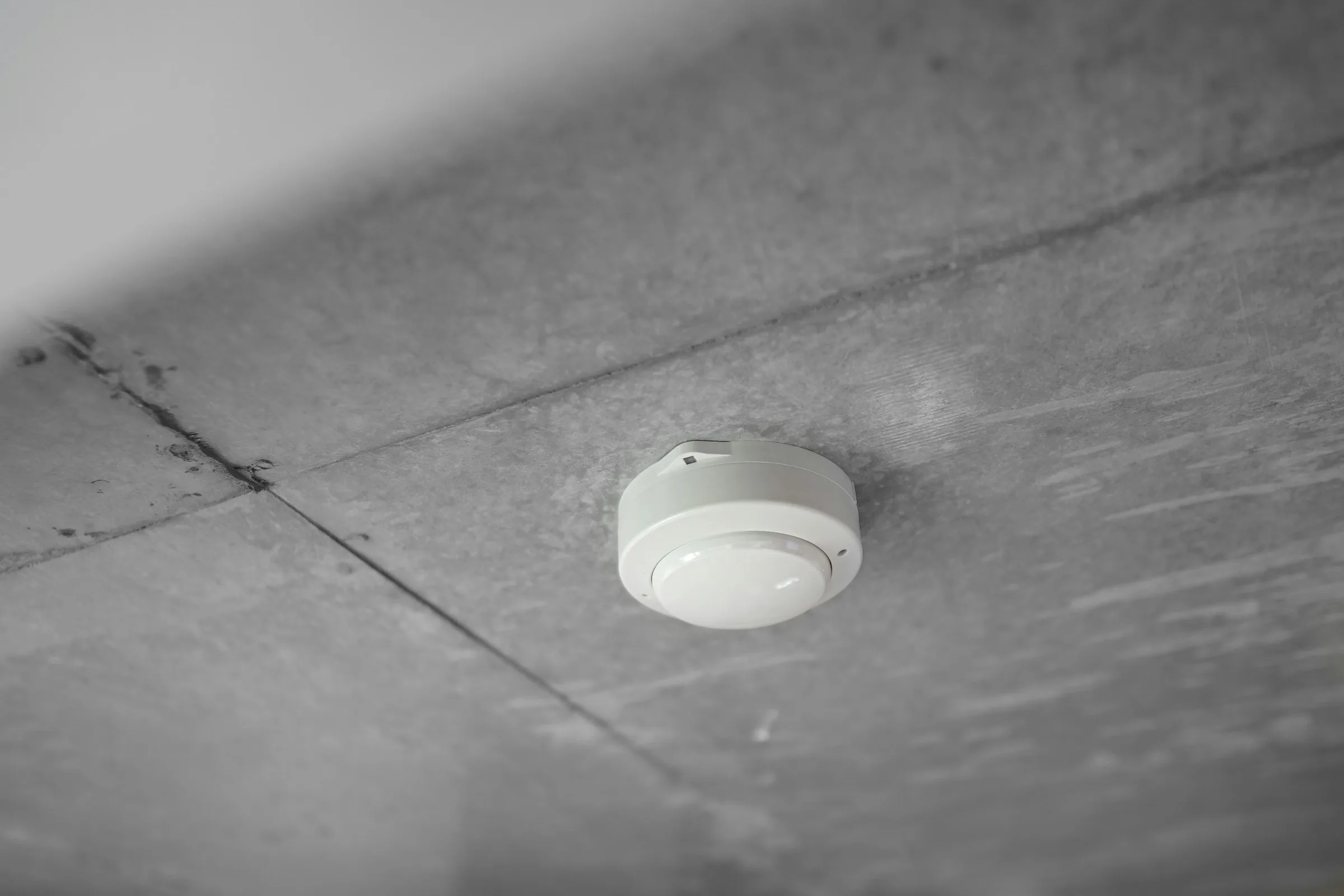
The Smoke and Carbon Monoxide Alarm (England) Regulations 2015 are the smoke alarm regulations for rented property. A landlord must make sure a smoke alarm is equipped on each storey with a room used wholly or partly as living accommodation. A carbon monoxide alarm is needed in any such room that contains a fixed combustion appliance other than a gas cooker. Alarms must be checked on the day a new tenancy begins and repaired or replaced once a tenant reports a fault. If a council has reasonable grounds to believe there is a breach, it serves a remedial notice first. A penalty of up to £5,000 can follow only if that notice is not complied with.
The short version
- Smoke alarms: at least one on every storey with a room used wholly or partly as living accommodation.
- Carbon monoxide alarms: one in each such room with a fixed combustion appliance. Gas cookers do not trigger the rule.
- Day one: the landlord, or someone for them, checks every alarm works when a new tenancy begins.
- After a report: repair or replace a faulty alarm as soon as reasonably practicable.
- Penalty: up to £5,000 for each unmet remedial notice (GOV.UK says per breach, not per property).
- 2026: a regulation in force from 1 May 2026 changed the “new tenancy” definition. The Renters’ Rights Act itself does not mention alarms.
How many smoke alarms does a rented home need?
The duty applies to a tenancy that gives someone the right to occupy a home as their only or main residence and provides for rent. Regulation 4 says a hall or landing is a room, and a bathroom or lavatory counts as a room used as living accommodation. A boiler in a bathroom therefore needs a carbon monoxide alarm. GOV.UK says a room is generally living accommodation if it is used for the primary purposes of living or someone spends significant time in it. Excluded tenancies include lodgers who share a toilet, washing facilities, kitchen or living room with the landlord or their family, long leases, student halls and care homes.
The number of storeys sets the smoke alarm count. A three-storey house needs at least three, however many bedrooms it has.
Which rooms need a carbon monoxide alarm?
Any room used wholly or partly as living accommodation that contains a fixed combustion appliance, which GOV.UK defines as a fixed apparatus that burns fuel of any type to generate heat. Since 1 October 2022 that includes gas and oil appliances as well as coal and wood. Before then the rule covered solid fuel appliances only (2022 Regulations, regulation 5).
| Appliance in the room | Carbon monoxide alarm? |
|---|---|
| Gas or oil boiler | Yes |
| Log-burning or multi-fuel stove | Yes |
| Fixed gas fire | Yes, on our reading (it burns fuel for heat and is not a cooker) |
| Boiler in a bathroom | Yes |
| Gas cooker or hob only | No |
| Decorative, non-functioning fireplace | No, in the department’s view |
GOV.UK’s landlord and tenant guide says carbon monoxide alarms should in general sit at head height, on a wall or shelf, about 1 to 3 metres from a possible source of carbon monoxide.
What must a landlord check on day one?
The landlord, or someone for them, must check that each alarm works on the day a new tenancy begins, meaning the day the tenant is entitled to possession. A “new tenancy” is one granted on or after 1 October 2022. A tenancy that replaces an earlier one with the same landlord, the same tenant and the same or substantially the same premises is not new.
GOV.UK says the landlord must keep a record of the tests, and gives a signed inventory on day one as one method.
What if a tenant reports a faulty alarm?
Once a tenant, or their nominated representative, reports a fault, the landlord must have the alarm repaired or replaced, and both the check of the report and the fix must happen as soon as reasonably practicable. GOV.UK advises tenants to try new batteries and report to the landlord if that fails or they cannot do it.
If a tenant prevents access, a landlord served with a remedial notice is not in breach of it if they show they took all reasonable steps, and not going to court does not by itself count against them (regulation 6). GOV.UK suggests writing to explain the requirement, offering convenient times and keeping a written record.
Which type of alarm should you fit?
The regulations set no type. GOV.UK recommends smoke alarms that meet BS 5839-6, carbon monoxide alarms that meet what it calls BS 50291, and sealed-for-life batteries over replaceable ones. A deaf or hard-of-hearing tenant may need alarms that vibrate or flash.
What happens if a landlord does not comply?
The route is in regulations 5 to 11:
- The council serves a remedial notice if it has reasonable grounds to believe there is a breach.
- The landlord has 28 days beginning with the day of service to act, and the same period to make written representations, which suspend the notice. If the council confirms it, the landlord has a further 21 days; if the council does not reply within 7 days of the 28 days ending, the notice is treated as withdrawn.
- If the landlord is still in breach and the occupier consents, the council arranges for someone to fit, repair or check the alarm, with at least 48 hours’ notice.
- The council may require a penalty charge of up to £5,000, giving at least 28 days to pay or ask for a review.
- After a review the landlord can appeal to the First-tier Tribunal, which can quash, confirm or vary the charge but not raise it.
Each council must publish a statement of principles for the amount; we have not checked Enfield’s.
Do licensed homes follow the same rules?
Licensed homes follow alarm conditions set by their licence instead. The 2015 regulations leave out an HMO that needs a licence under Part 2 of the Housing Act 2004 and a house that needs one under Part 3, which includes a flat (regulation 2). Schedule 4 says licences granted from 1 October 2022 must include conditions requiring a smoke alarm on each such storey and a carbon monoxide alarm in rooms with a fixed combustion appliance (other than a gas cooker), plus a declaration on demand. Breaching a licence condition is an offence under section 95.
Enfield’s selective licensing started on 1 September 2026 and covers only the 17 wards the council lists, and some tenancies are exempt. On our reading it is a Part 3 scheme, and the application asks for the location of smoke and carbon monoxide detectors. A home outside the scheme, or exempt, follows the 2015 regulations, and while an application is pending the safe course is to comply with them anyway. See our Enfield licensing article.
Did the Renters’ Rights Act change the alarm rules?
We searched the current text of the Renters’ Rights Act 2025 for “smoke”, “carbon monoxide” and “alarm” and found no match. One consequential regulation did touch them. Regulation 11 of S.I. 2026/325, in force from 1 May 2026 for private assured tenancies, removed the exclusion from “new tenancy” for a periodic shorthold tenancy arising when a fixed term ends. The exclusion for a replacement tenancy with the same landlord, tenant and premises remains. On our reading, a tenancy that continues as a periodic tenancy was not granted afresh and needs no new day-one check, while a new tenant or different premises is a new tenancy. We found no official guidance on this, so ask the council or a solicitor about a borderline case.
Regulation 8(2) of the alarm regulations still reads £5,000 on legislation.gov.uk. GOV.UK’s Renters’ Rights Act penalty guidance does not cover these regulations.
A worked example and room-by-room checklist
This is an invented illustration. A three-storey house in Edmonton has a kitchen with a gas boiler and hob, a living room with a log stove, bedrooms and a bathroom on the first floor, and a loft bedroom above.
| Where | Alarm | Why |
|---|---|---|
| Ground-floor hall | Smoke | Storey one |
| First-floor landing | Smoke | Storey two |
| Second-floor landing | Smoke | Storey three |
| Kitchen | Carbon monoxide | Boiler (we treat a kitchen as a room people spend time in); a hob alone would not trigger it |
| Living room | Carbon monoxide | The stove burns solid fuel |
That is five alarms as a minimum. The tenancy begins on 2 February 2027, so the landlord or agent tests all five that day and records it on the signed inventory. On 20 April 2027 the tenant reports the living room alarm is faulty, and the landlord should arrange a repair or replacement as soon as reasonably practicable. If the council later served a remedial notice in person on 1 June 2027, the 28 days beginning that day would end on 28 June 2027.
Our landlord legislation guide sets this beside the gas, electrical and EPC checks, and the licensing guide covers local schemes. Tenants can read your rights. If you are thinking of letting a home in Edmonton, talk to our lettings team.
Questions readers ask
How many smoke alarms does a rented home need?
At least one on each storey that has a room used wholly or partly as living accommodation. The regulations treat a bathroom or lavatory as living accommodation and a hall or landing as a room. GOV.UK’s guidance says smoke alarms should in general be fixed to the ceiling in a hall or landing, and that landlords should follow the manufacturer’s instructions.
Does a gas boiler need a carbon monoxide alarm?
Yes, if the boiler is in a room used wholly or partly as living accommodation. A gas boiler is a fixed combustion appliance, and the regulations require a carbon monoxide alarm in any such room, except where the only appliance is a gas cooker. Gas and oil appliances were added to the rule on 1 October 2022.
Does a wood-burning stove need a carbon monoxide alarm?
Yes. A log-burning stove is a fixed combustion appliance, and solid fuel appliances were already covered before the 2022 amendment. GOV.UK says that in the department’s view a non-functioning, purely decorative fireplace would not count as a fixed combustion appliance.
Who has to test the alarms, the landlord or the tenant?
The landlord must make sure the alarms are checked on the day a new tenancy begins. The regulations set no routine testing duty after day one. GOV.UK advises a tenant who finds an alarm not working to replace the batteries and, if that fails or they cannot do it, to tell the landlord. Once told, the landlord must repair or replace the alarm as soon as reasonably practicable.
What is the penalty if a landlord does not comply?
The council first serves a remedial notice. If the landlord does not comply with it, the council can require a penalty charge of up to £5,000, and GOV.UK says fines are applied per breach rather than per landlord or property. The landlord can ask for a review and then appeal to the First-tier Tribunal.
Sources
- legislation.gov.uk, Smoke and Carbon Monoxide Alarm (England) Regulations 2015, read on 17 October 2026.
- legislation.gov.uk, Smoke and Carbon Monoxide Alarm (Amendment) Regulations 2022, read on 17 October 2026.
- legislation.gov.uk, S.I. 2026/325, regulation 11, read on 17 October 2026.
- legislation.gov.uk, Housing Act 2004, Schedule 4 and section 95, read on 17 October 2026.
- legislation.gov.uk, Renters’ Rights Act 2025, read on 17 October 2026.
- GOV.UK, Guidance for landlords and tenants, published 29 July 2022, read on 17 October 2026.
- GOV.UK, Guidance for local authorities, published 29 July 2022, read on 17 October 2026.
- GOV.UK, Civil penalties under the Renters’ Rights Act 2025, published 13 November 2025.
- Enfield Council, Selective licensing scheme, read on 17 October 2026.